

Reading as Relationship: Simple Practices for Meaningful Conversations Around Books
One of the quiet pressures many parents feel after encountering a thoughtful book list goes something like this: Okay… but now what?
I know I’ve felt it. You find good books. Beautiful books. Worthy books. And then you’re left wondering how to hold them well—how to move from choosing stories to actually living with them in a way that feels natural and nourishing rather than performative.
How do we engage our children around books without turning reading into another thing to manage?
The good news is that meaningful literary conversations don’t require expertise, lesson plans, or the right set of questions asked at the right time. At their heart, they are relational. When we read together, we’re not just sharing stories—we’re practicing attention. We’re learning how to listen, how to wonder aloud, how to sit with ideas and emotions without rushing to tidy them up.

The goal isn’t to extract the “right takeaway.” It’s to create a space where thoughts and feelings are welcome, and where meaning unfolds slowly, through presence and conversation.
What follows aren’t techniques so much as rhythms—ways of being with books and with one another that work whether you homeschool or not, whether you’re reading picture books at bedtime or a novel stretched across many weeks.
Shifting the Goal: From Comprehension to Connection
Before we talk about conversation, it helps to name what we’re aiming for.
Many of us were shaped by an approach to reading that emphasized mastery: summarize the plot, identify the theme, answer the questions correctly. Those skills have their place, but relational reading begins somewhere else.
Instead of asking, Did they understand the book?
We might ask, Did the book open something between us?
Did it stir curiosity? Did it bring up a question or a feeling? Did it invite disagreement, wonder, or quiet reflection?
When we read with connection in mind, conversations begin to feel less like assessments and more like invitations—an opening rather than a conclusion.
Noticing What We Notice
One of the simplest—and most generous—ways to begin a conversation is with this question:
What stood out to you?
Not what was important. Not what you think you should say. Just what caught your attention.
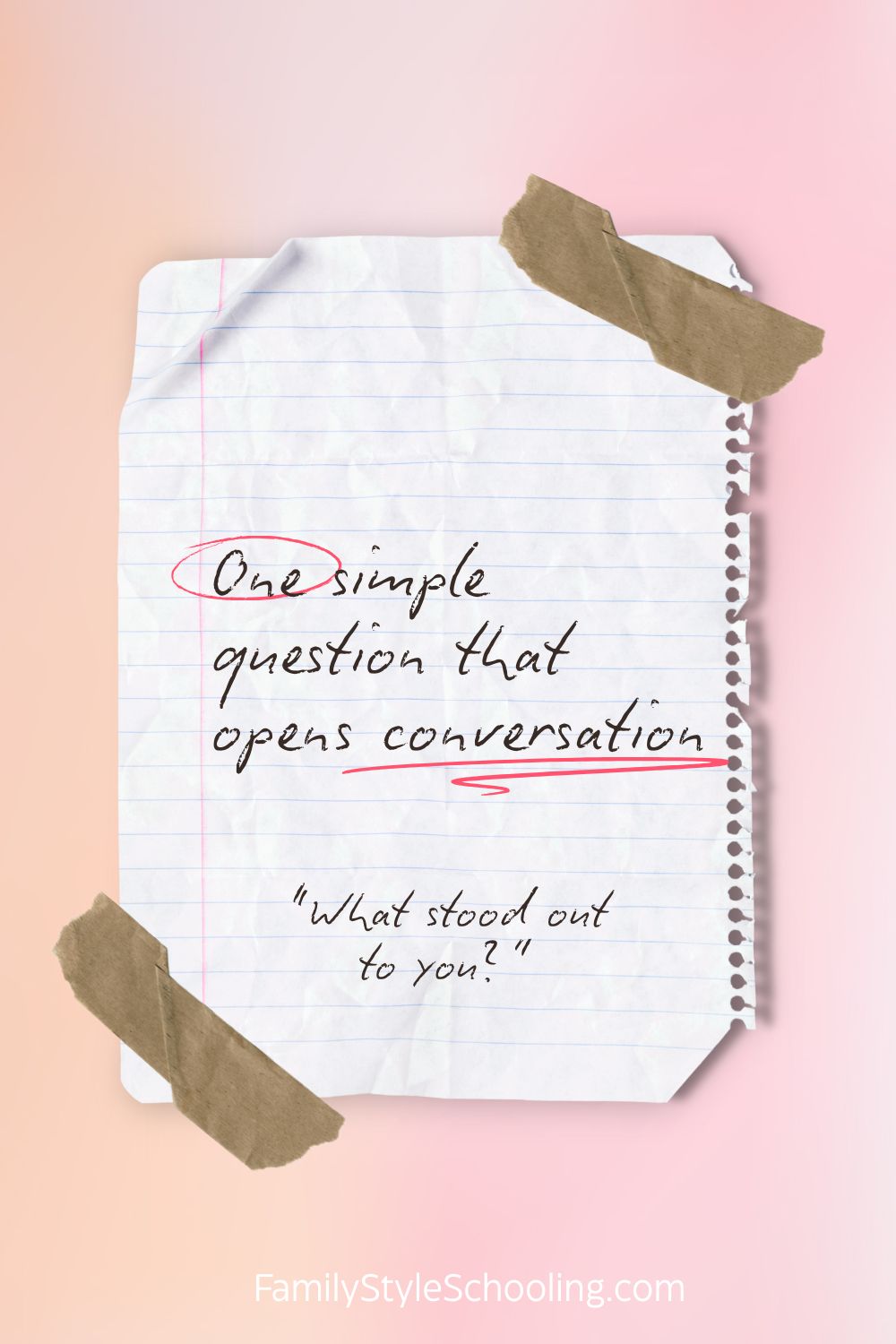
This question lowers the pressure immediately. There is no wrong answer here—only honest noticing. One child may mention a tiny detail. Another may jump straight to a moment that felt heavy or confusing. Both responses are meaningful because they tell you how that child is meeting the story.
Over time, this rhythm teaches children to trust their own perceptions. It also teaches us, as parents, how to listen without steering too quickly.
Asking Open Questions—and Letting Them Rest
Good literary questions don’t demand precision. They invite possibility.
Rather than stacking question after question, try offering one open-ended prompt and then leaving space for it to land.
You might wonder aloud:
- Why do you think that mattered to them?
- What do you think the character was hoping for?
- What part felt unfinished or confusing?
Silence isn’t a sign that something has gone wrong. Often it’s a sign that something real is happening. Some children need time to find language. Others will return to the conversation hours—or days—later, once the story has had time to work its way into their thinking.
When we resist the urge to fill every pause, we communicate something important: their thoughts are worth waiting for.
Making Room for Disagreement
One of the gifts of literature is the safe distance it provides. Children can wrestle with ideas without having to live them yet. That makes disagreement not something to fear, but something to welcome.
If a child says, “I don’t like what that character did,” it can be tempting to explain or correct. But often the better response is curiosity.
Tell me more.
Even when children disagree with our interpretations, those moments can deepen trust. They learn that thoughtful disagreement doesn’t threaten relationship—that conversation can hold tension without breaking.
Quietly, this forms discernment and courage. It teaches children that their voice matters.

Naming Feelings, Values, and Tensions Together
Stories give us language for inner worlds—often before we have words for our own.
When we help children name what’s happening beneath the surface of a story, we’re offering tools they’ll carry far beyond books.
You might say:
- That moment felt heavy—do you think it was sadness or disappointment?
- It seems like the character wanted two things at once. Have you ever felt that pull?
- What do you think mattered most to them in that choice?
These conversations don’t need to resolve neatly. Often, naming is enough. Over time, children learn that emotions, values, and tensions are worth paying attention to—and that complexity is part of being human.
Letting the Conversation Keep Going
Not every conversation needs to happen the moment the book closes.
Some of the richest discussions emerge sideways—while washing dishes, driving in the car, or days later when a story suddenly connects to something real. When a child brings a book back up on their own, treat that as a gift. It’s a sign the story is still working in them.
Reading as relationship honors this slow, organic unfolding. It trusts that meaning doesn’t need to be forced. It grows through shared attention and time.
Reading Together as Formation
At its core, reading together isn’t about producing impressive insights or checking educational boxes. It’s about practicing how to be with one another—to listen, to wonder, to disagree kindly, and to sit with ideas that don’t resolve quickly.
When books become places of shared conversation rather than pressure, they shape not just readers, but people.
If you’re looking for resources that support this kind of relational, conversation-centered reading—book recommendations, gentle prompts, and shared practices—you’ll find more inside the Rooted Minds Book Nook, where stories are treated not as assignments, but as companions for the long work of formation.

Betsy Strauss is an unexpected homeschooler, mother of three, who is in a relationship with a sweet man for life. She loves reading books, drinking coffee, and learning anything with her kids.